
Torque Converter Calculator: How to Pick the Right Stall Speed for Your Setup
Enter any torque value in your preferred unit and get all conversions instantly.
* SAE HP tested with all accessories. PS (metric HP) = 0.9863 SAE HP. BHP ≈ SAE HP ±1–2%. kW is the SI unit for power. All torque conversions referenced to lb·ft baseline.
A torque converter calculator takes the black magic out of one of the most misunderstood parts of an automatic transmission build. Stall speed, K-factor, torque multiplication — these numbers get thrown around at the track and on forums, but most people are guessing. The truth is, your converter needs to match your engine's torque curve, your vehicle weight, your rear gear, and what you actually do with the car.
Our torque converter calculator above does exactly that. Plug in your peak torque, torque RPM, vehicle weight, gear ratio, and tire size, and it spits out a recommended stall speed based on real fluid-coupling math. If you already have a converter and want to know what engine it belongs behind, flip to "Match Converter" mode and work backwards.
For a broader look at how automatic transmissions work, TCI Automotive has a solid breakdown of torque converter fundamentals. If you are building a street-strip car, Hughes Performance explains how stall speed affects drivability better than most.
What Stall Speed Actually Means
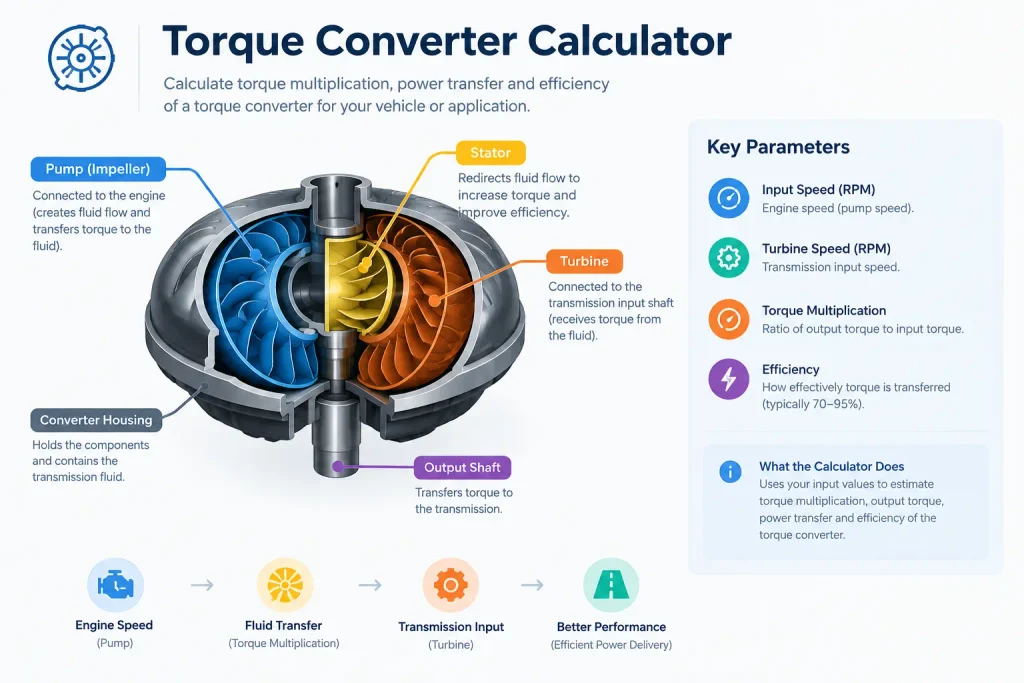
Stall speed is the RPM your engine hits when you mat the throttle against the brake and the car does not move. At that moment, the impeller inside the converter is spinning, the turbine is barely moving, and the fluid is doing all the work. The RPM where this equilibrium happens is your stall speed.
Pick a converter with too low a stall, and your engine lugs off the line, bogging because it is below its power band. Pick one with too high a stall, and you are slipping all day on the street, generating heat, killing mileage, and wearing out the transmission. A good torque converter calculator keeps you in the window where your engine makes power without frying the fluid.
The standard formula is simple:
Stall RPM = K × √(Peak Torque in lb-ft)
K is the converter's K-factor — essentially how "tight" or "loose" the converter is. A stock towing converter might have a K of 18–22. A street performance unit sits around 25–30. Full race converters can run 35–45 or higher.
How Vehicle Weight Changes Everything
The same converter behind a 2,500-pound street rod and a 4,500-pound muscle car will behave completely differently. Weight is leverage against the converter. A heavier vehicle needs more torque to get moving, which effectively raises the flash stall — the RPM the converter flashes to when you stomp the gas at cruise.
Our torque converter calculator applies a weight correction factor:
- Under 3,000 lbs: +10% stall
- 3,000–3,500 lbs: baseline
- 3,500–4,000 lbs: –5% stall
- 4,000–4,500 lbs: –10% stall
- Over 4,500 lbs: –15% stall
That means if the math says you need a 3,000 RPM stall for a 3,200-pound car, the same converter in a 4,800-pound truck will act more like a 2,550 RPM unit. The torque converter calculator handles that adjustment automatically.
Gear Ratio and Tire Diameter Matter Too
Rear axle ratio and tire size change the mechanical advantage the engine has against the vehicle mass. Lower numerical gears (like 2.73:1) reduce wheel torque, so the converter flashes higher to compensate. Steeper gears (4.56:1) multiply torque so aggressively that the converter does not need to slip as much.
Tire diameter works the same way. A 30-inch tall tire is like a taller overdrive — it reduces effective gear ratio. A 26-inch drag slick is the opposite. The torque converter calculator normalizes everything to a 26-inch reference tire and applies a correction based on what you are actually running.
Use Case: Street vs. Strip vs. Towing
The torque converter calculator splits applications into four categories, each with a different target stall relative to your peak torque RPM:
Street / Daily Driver: 60% of peak torque RPM. You want the converter to flash right where the engine starts making real power, but still lock up and drive like stock at cruise. Too much stall on the street turns your transmission into a slush box.
Street / Strip: 70% of peak torque RPM. A little looser for the track, but still streetable. This is the compromise zone — enough stall to leave hard, not so much that highway driving becomes annoying.
Drag Racing: 85% of peak torque RPM. All about the launch. These converters are loose, generate heat, and are not meant for stoplight-to-stoplight driving. The torque converter calculator will warn you with a higher stall number here because that is exactly what the car needs at the strip.
Towing / Heavy Duty: 50% of peak torque RPM. Low stall, high torque multiplication, minimal slip. You want the engine pulling from down low without the converter wasting energy as heat. Towing with a high-stall converter is a fast way to cook your transmission.
Torque Multiplication and Why It Matters
At stall, a torque converter is not just a clutch replacement — it is a torque multiplier. The stator redirects fluid back to the impeller, amplifying torque before it ever hits the turbine. Stock converters multiply roughly 1.8:1 to 2.0:1. Performance converters hit 2.2:1. Full race units can reach 2.4:1 or higher.
That means a 400 lb-ft engine with a 2.2:1 converter is sending 880 lb-ft to the transmission at launch. The torque converter calculator estimates this multiplication based on your selected converter type (stock, performance, or race) and use case.
How to Use the Torque Converter Calculator
Mode 1: Find Stall Speed
- Enter your engine's peak torque and the RPM where it happens (from your dyno sheet or factory specs).
- Enter vehicle weight — as-raced weight, not curb weight. Include driver and fuel.
- Enter your rear gear ratio and tire diameter.
- Pick your use case and converter type.
- Hit Calculate. The torque converter calculator returns your recommended stall, K-factor, torque multiplication, and estimated converter diameter.
Mode 2: Match Converter
- Enter the stall RPM printed on your converter (or measured on a trans brake).
- Optionally enter the K-factor or converter diameter.
- The torque converter calculator reverse-engineers the matched engine torque range and tells you what class of vehicle that converter belongs in.
Reading the Results
The result card shows three key numbers:
- Base Stall: The raw math before safety margin.
- With Margin: Adds your chosen safety margin (default 10%) to account for real-world variation in fluid temperature, converter wear, and manufacturer tolerances.
- K-Factor: The converter's efficiency constant. Lower K = tighter converter. Higher K = looser converter.
The stall speed gauge visualizes where you land on the 0–6,000 RPM spectrum. Detail rows break down torque multiplication, converter diameter estimate, and your effective gear ratio at the tire.
Bottom Line
Do not guess on stall speed. The wrong converter costs you ET at the track, drivability on the street, or transmission life everywhere. Use the torque converter calculator to match your converter to your engine, your weight, your gears, and your actual goals. Get the numbers right once, and the car will drive like it should.
FAQs
How do you convert Nm to ft-lb?
Multiply the Newton-meter value by 0.73756.
Example:
100 Nm = 73.76 ft-lb
Why is torque important in engines?
Torque determines how quickly a vehicle can accelerate and pull heavy loads.
What torque unit is used in the USA?
The United States commonly uses foot-pounds (ft-lb) for automotive torque measurements.
What torque unit is used in engineering?
Most engineers use Newton-meters (Nm) because it is the SI unit of torque.