
Speed Converter: The Fastest Way to Convert Any Speed Unit
Need to convert mph to km/h before a road trip abroad, or knots to miles per hour for a sailing adventure? A speed converter takes the guesswork out of unit conversion. This free online tool instantly converts any speed — from everyday miles per hour to the mind-bending speed of light — with pinpoint accuracy. Just enter your value, choose your units, and get your result in seconds.
Below, you'll learn how speed is measured, the formula behind every conversion, and which units pilots, sailors, and scientists actually use.
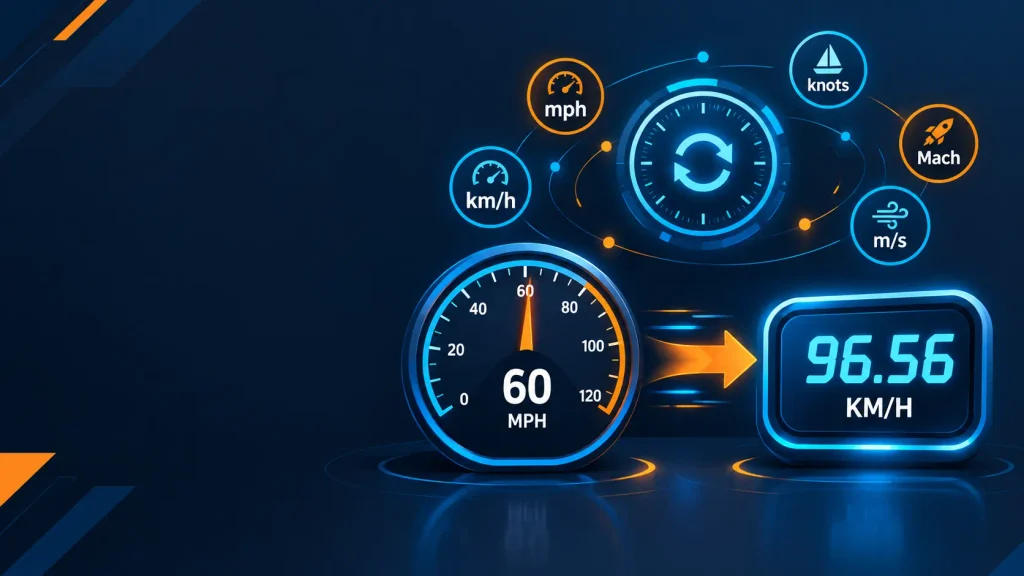
How to Use the Speed Converter
Using the speed converter couldn't be simpler:
- Select your "Convert From" unit — for example, miles per hour
- Select your "Convert To" unit — for example, kilometers per hour
- Enter your value and hit convert
The result appears instantly, with no sign-up and no downloads required.
How Do You Calculate Speed?
Every speed conversion is built on one fundamental formula:
Speed = Distance ÷ Time
An object that covers a lot of distance in a short time is moving fast; one that crawls a short distance over a long period is moving slowly. If you know any two of the three variables, you can solve for the third. Try our speed calculator to work backwards from distance and time.
Common Speed Units Explained
Not all speed measurements are created equal. Here's who uses what — and why:
- Miles per hour (mph) — the standard for road speed in the United States and the UK
- Kilometers per hour (km/h) — used on roads virtually everywhere else in the world
- Knots (kn) — the universal unit for maritime and aviation navigation, equal to one nautical mile per hour
- Meters per second (m/s) — the scientific standard in physics and engineering
- Feet per second (ft/s) — common in ballistics and sports science
- Mach — a ratio comparing speed to the speed of sound; Mach 1 equals roughly 767 mph
- Speed of light (c) — the universe's ultimate speed limit: 670,616,629 mph
Fun fact: the speed of sound travels at about 767.27 mph, which is why a jet breaking the sound barrier creates a sonic boom.
Speed Conversion Table: Quick Reference
Bookmark these essential conversions, or skip the math entirely with our speed converter:
| From | To Miles Per Hour | To Kilometers Per Hour | To Meters Per Second |
|---|---|---|---|
| 1 mph | 1 mph | 1.609 km/h | 0.447 m/s |
| 1 km/h | 0.621 mph | 1 km/h | 0.278 m/s |
| 1 knot | 1.151 mph | 1.852 km/h | 0.514 m/s |
| 1 m/s | 2.237 mph | 3.6 km/h | 1 m/s |
| Mach 1 | 767.27 mph | 1,235 km/h | 343 m/s |
Popular Speed Conversions
Some conversions come up far more often than others:
- mph to km/h converter — essential for American drivers in Europe or Canada
- km/h to mph converter — for international visitors driving in the US
- ft/s to mph converter — popular in sports and physics homework
- mph to m/s converter — the bridge between everyday and scientific units
Why Use an Online Speed Converter Instead of Manual Math?
Manual conversion means hunting down the right factor, multiplying carefully, and hoping you didn't misplace a decimal. One slip turns 60 mph into 600 km/h. Our speed converter eliminates human error entirely — it applies precise conversion factors instantly, handles units from centimeters per second to the speed of light, and saves you from memorizing a dozen different formulas.
Frequently Asked Questions
What's the difference between speed and velocity? Speed measures how fast something moves; velocity also includes direction. Our converter handles speed units — direction is up to you!
How many mph is the speed of light? Approximately 670,616,629 mph — or about 873,000 times faster than sound.
Why do ships and planes use knots instead of mph? A knot equals one nautical mile per hour, and nautical miles align directly with latitude degrees on Earth's surface, making navigation calculations far simpler.