
Engine Torque Calculator — Find Torque, HP & RPM Instantly
Peak torque typically occurs at lower RPM than peak power. Enter the RPM at which you want torque calculated.
* SAE HP uses the 5252 constant. BHP (brake horsepower) is numerically close but measured at the flywheel. kW = HP × 0.7457. All torque conversions from lb·ft baseline.
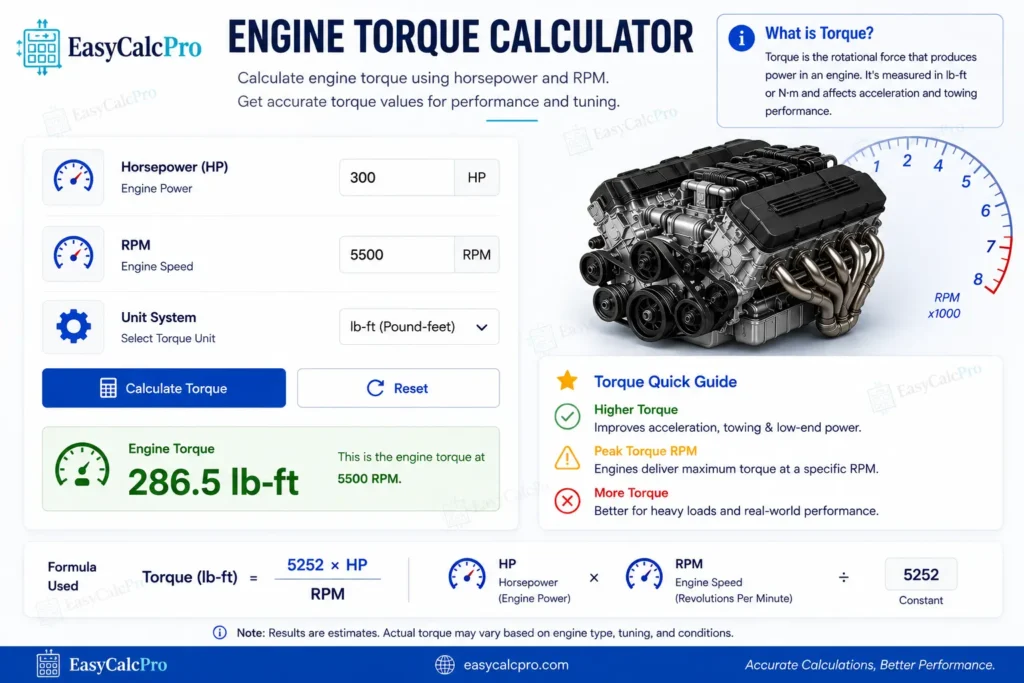
Whether you're tuning a performance build, verifying dyno numbers, or just trying to understand what your engine is actually doing under the hood, the relationship between torque, horsepower, and RPM can feel like a maze of confusing figures. Miss the math and you risk wrong gear ratios, overloaded drivetrain components, or wasted money on modifications that don't deliver. Our Engine Torque Calculator cuts through the confusion instantly — enter any two values and get the third, with full unit conversions across lb·ft, N·m, kW, and PS, so whether you're working in a garage or spec'ing a build on paper, the numbers are always clear.
What Is Engine Torque?
Torque is the rotational force your engine produces. Think of it this way: if you attach a wrench to a bolt and push on it, the force you apply multiplied by the length of the wrench handle is torque. Your engine does the exact same thing — the pistons push on the crankshaft, and the result is a twisting force measured in pound-feet (lb·ft) or Newton-metres (N·m).
In everyday driving terms, torque is what you feel. It's the shove that pushes you back in your seat when you accelerate hard from a standstill. It's what lets a truck pull a trailer. It's what makes a diesel engine feel so effortlessly strong at low speeds even when its horsepower rating looks modest on paper.
Horsepower, on the other hand, is how fast you can keep applying that torque. It's a rate — how much work the engine can do over time. A small engine with high RPM can match the horsepower of a large engine with lower RPM, but the character of that power will feel completely different.
Understanding the difference between the two — and how they relate to engine speed — is the foundation of every performance decision you'll ever make about a vehicle.
What Is an Engine Torque Calculator?
An Engine Torque Calculator is a digital tool that uses the mathematical relationship between torque, horsepower, and RPM to solve for whichever value you don't know. You plug in two numbers, and it calculates the third.
It also handles the messy unit conversion work that trips up engineers and enthusiasts alike — converting between lb·ft and N·m, between SAE horsepower and kilowatts, between metric PS and British BHP. A good calculator does all of that automatically so you can focus on the engineering decision, not the arithmetic.
Beyond the basic torque-HP-RPM triangle, an advanced engine torque calculator can also compute torque from a physical force applied at a distance (the lever arm formula), which is essential for bolt torque specs, fastener tightening, and mechanical advantage calculations.
Who Needs This Calculator?
This tool is genuinely useful across a wide range of people:
Performance and racing enthusiasts use it to cross-check dyno sheets, plan gear ratios, and understand where peak torque and peak power occur in their RPM range. If a dyno says your engine makes 380 lb·ft at 4,200 RPM, the calculator can instantly confirm whether the claimed horsepower figure is accurate.
Automotive technicians and mechanics use it to verify manufacturer specifications, diagnose inconsistencies in engine data, and communicate performance figures in whichever unit system their customer or shop software uses.
Engineers and students use it for coursework, design projects, and checking calculations. The lever arm mode is particularly useful for anyone working with mechanical systems — from engine mounts to suspension components to industrial machinery.
Diesel truck and towing communities are obsessed with torque, and rightly so. Understanding exactly how much torque your engine produces at your typical towing RPM helps you make smarter decisions about load limits, gear selection, and transmission programming.
Import car enthusiasts often encounter specifications in PS or kW and need to compare them against American HP ratings. The unit conversion functions handle this instantly.
Fleet managers and buyers comparing vehicles across different markets benefit from having all power figures converted into a consistent unit so comparisons are apples-to-apples.
The Core Formula: Torque, Horsepower, and RPM
The mathematical relationship between these three values is built on one elegant equation:
The Standard Power Equation
Horsepower = (Torque × RPM) ÷ 5252Or rearranged:
Torque (lb·ft) = (Horsepower × 5252) ÷ RPM
RPM = (Horsepower × 5252) ÷ Torque
Where Does 5252 Come From?
The constant 5,252 is not arbitrary. It comes from the definition of horsepower itself.
James Watt, who coined the term in the 1780s, defined one horsepower as the ability to do 33,000 foot-pounds of work per minute. Translating that into rotational terms:
- One revolution covers a distance of 2π times the radius
- So work per revolution = Torque × 2π
- Power = Work per minute = Torque × 2π × RPM
- Converting to horsepower: HP = (Torque × 2π × RPM) ÷ 33,000
Simplifying: 33,000 ÷ (2π) = 5,252.11...
That's why 5,252 appears in the formula. And it explains a famous fact that confuses many people when they first encounter a dyno chart:
At exactly 5,252 RPM, torque (in lb·ft) and horsepower are always numerically equal. Below that RPM, torque is higher. Above it, horsepower is higher. The two curves always cross at that exact point.
The Lever Arm Formula: Torque from Force
When calculating torque from a physical force — like tightening a bolt with a wrench — the formula is different:
Torque = Force × Lever Arm Length × sin(θ)Where:
- Force (F) is how hard you're pushing or pulling, measured in pounds-force (lbf) or Newtons (N)
- Lever Arm (r) is the distance from the pivot point to where the force is applied (in feet or metres)
- θ (theta) is the angle between the direction of force and the lever arm
When force is applied perfectly perpendicular to the lever arm (θ = 90°), sin(90°) = 1, so the formula simplifies to:
Torque = Force × Lever Arm LengthThis is the most common scenario — a wrench, a pedal, a bolt. For non-perpendicular forces (like a cable pulling at an angle), the sin(θ) correction factor reduces the effective torque.
Practical example: A torque wrench applies 50 lbf of force at 1.5 feet from the pivot point, perpendicular to the handle:
Torque = 50 lbf × 1.5 ft × sin(90°) = 75 lb·ftAll Formulas at a Glance
| What You Want | Formula | Notes |
|---|---|---|
| Torque (lb·ft) | (HP × 5252) ÷ RPM | SAE HP, RPM at measurement point |
| Horsepower (HP) | (Torque × RPM) ÷ 5252 | Torque in lb·ft |
| Engine RPM | (HP × 5252) ÷ Torque | Finds RPM where both values coexist |
| Torque (N·m) | (kW × 9549) ÷ RPM | SI unit equivalent |
| Power (kW) | (Torque × RPM) ÷ 9549 | Torque in N·m |
| Torque from force | F × r × sin(θ) | Physical lever arm calculation |
Unit Conversion Constants
| From | To | Multiply by |
|---|---|---|
| lb·ft | N·m | × 1.35582 |
| N·m | lb·ft | × 0.73756 |
| lb·ft | kgf·m | × 0.13826 |
| lb·ft | lb·in | × 12 |
| HP (SAE) | kW | × 0.74570 |
| kW | HP (SAE) | × 1.34102 |
| HP (SAE) | PS / CV | × 1.01387 |
| PS | kW | × 0.73550 |
| BHP | kW | × 0.74570 |
Understanding the Torque and Horsepower Curves
One of the most valuable outputs of engine testing is the dyno chart — a graph that shows torque and horsepower across the entire RPM range. Understanding these curves transforms how you think about an engine.
The Typical Curve Shape
For most naturally aspirated petrol engines, torque peaks at a moderate RPM and then gradually falls off as engine speed climbs. Horsepower, because it's torque multiplied by RPM, keeps rising even as torque starts to decline — but only until the torque drops faster than RPM rises. At that crossover point, horsepower peaks too.
The result is a characteristic shape: torque is a broad hump that crests early, horsepower is a rising line that peaks late, and they cross at 5,252 RPM every single time.
Torque and Power at Key RPM Points (Typical 400 HP / 400 lb·ft Engine)
| RPM | Torque (lb·ft) | Horsepower (HP) |
|---|---|---|
| 1,000 | 315 | 60 |
| 2,000 | 370 | 141 |
| 3,000 | 390 | 222 |
| 4,000 | 405 | 309 |
| 4,500 | 400 | 343 |
| 5,252 | 400 | 400 ← curves cross |
| 6,000 | 380 | 434 |
| 6,500 | 355 | 440 |
| 7,000 | 325 | 434 |
| 7,500 | 290 | 414 |
This table illustrates a core truth: the torque curve determines how the car feels in everyday driving, while the horsepower peak determines the top-end performance ceiling.
Diesel vs Petrol Torque Profiles
Diesel engines produce torque very differently from petrol engines. High cylinder pressure from compression ignition means diesels generate massive torque at very low RPM — often the peak occurs at 1,500–2,000 RPM — and the curve stays relatively flat across the midrange. This is why a diesel truck with "only" 250 HP can feel stronger pulling a load than a 300 HP petrol engine.
Petrol engines produce peak torque higher in the RPM range, often at 3,500–5,000 RPM for naturally aspirated engines, and need to be revved to access that power.
Turbocharged engines of both types shift the torque curve, bringing peak torque lower and holding it flatter across a broader RPM range — a phenomenon called a "flat torque plateau."
Torque Figures for Well-Known Engine Types
| Engine Type | Typical Peak Torque | Peak Torque RPM |
|---|---|---|
| 1.0L 3-cylinder petrol | 90–110 lb·ft | 3,000–4,500 RPM |
| 2.0L naturally aspirated 4-cyl | 140–160 lb·ft | 3,500–4,500 RPM |
| 2.0L turbocharged 4-cyl | 200–280 lb·ft | 1,600–3,000 RPM |
| 3.5L V6 naturally aspirated | 260–300 lb·ft | 3,500–5,000 RPM |
| 3.5L twin-turbo V6 | 380–450 lb·ft | 2,000–3,500 RPM |
| 5.0L V8 naturally aspirated | 380–430 lb·ft | 4,000–5,000 RPM |
| 6.7L diesel I6 (light truck) | 850–1,000 lb·ft | 1,600–2,800 RPM |
| Electric motor (mid-range EV) | 300–670 lb·ft | 0–100 RPM (instant) |
The electric motor row is instructive: EVs produce maximum torque from zero RPM, which is why they feel so quick off the line despite modest power ratings compared to performance petrol cars.
How to Use the Engine Torque Calculator
The calculator has four modes. Here's when and how to use each one.
Mode 1: Find Torque (HP + RPM → Torque)
Use this when: You know a car's advertised horsepower and the RPM at which that power is produced, and you want to find the torque at that point.
Step-by-step:
- Select "Find Torque" mode
- Enter the horsepower figure (choose your unit: HP, kW, PS, or BHP)
- Enter the RPM at which that power is produced
- Hit Calculate
Example: A manufacturer claims 350 HP at 6,000 RPM. What is the torque?
Torque = (350 × 5252) ÷ 6000 = 306 lb·ftIf that same car's spec sheet claims 330 lb·ft, something doesn't add up at that RPM — a useful check for detecting marketing numbers that don't match.
Mode 2: Find Horsepower (Torque + RPM → HP)
Use this when: You have a torque figure from a dyno measurement or a spec sheet and want to calculate the power output.
Step-by-step:
- Select "Find Horsepower" mode
- Enter the torque (lb·ft, N·m, kgf·m, or lb·in)
- Enter the RPM
- Hit Calculate
Example: Your dyno shows 410 lb·ft at 4,800 RPM. What's the horsepower?
HP = (410 × 4800) ÷ 5252 = 375 HPMode 3: Find RPM (HP + Torque → RPM)
Use this when: You know both the power and torque claimed for an engine and want to verify what RPM those values should occur simultaneously.
Step-by-step:
- Select "Find RPM" mode
- Enter the horsepower
- Enter the torque
- Hit Calculate
Example: A spec sheet claims 400 HP and 400 lb·ft. At what RPM do these coexist?
RPM = (400 × 5252) ÷ 400 = 5,252 RPMExactly 5,252 — confirming the 5,252 rule perfectly. If the claimed figures gave a different RPM, one of the values is either measured at a different point or is inaccurate.
Mode 4: Force & Lever Arm (F × r → Torque)
Use this when: You're working with physical forces — torque wrench calculations, fastener tightening specs, clutch pedal effort, or any situation where a force acts at a distance.
Step-by-step:
- Select "Force & Lever" mode
- Enter the force applied (lbf, N, kN, or kgf)
- Enter the lever arm length (distance from pivot to force application point)
- Enter the angle (default 90° for perpendicular force)
- Hit Calculate
Example: A mechanic applies 80 lbf to a breaker bar 2 feet long at a 90° angle:
Torque = 80 × 2 × sin(90°) = 160 lb·ftIf the force is applied at 60° instead:
Torque = 80 × 2 × sin(60°) = 80 × 2 × 0.866 = 138.6 lb·ftThis is why manufacturers specify torque wrench settings rather than force — the angle variation would make force-based specs unreliable.
Torque vs Horsepower: The Age-Old Debate
There's a saying that gets thrown around in automotive circles: "Horsepower sells cars, torque wins races." It's catchy, but it's an oversimplification. The truth is more nuanced.
Torque determines acceleration feel at any given moment. More torque means the engine can resist being slowed down more effectively, accelerate more strongly from any point in the RPM range, and pull heavier loads. For daily driving, towing, and off-road use, torque is the figure that matters most.
Horsepower determines top speed and sustained high-RPM performance. At high speeds, aerodynamic drag grows exponentially, and overcoming it requires sustained power output. Track driving, high-speed highway cruising, and sustained acceleration at elevated speeds all favor engines with high peak horsepower.
Neither alone tells the whole story. A narrow, peaky powerband can produce the same peak horsepower as a broad, flat one — but the broad engine will feel dramatically faster in real-world use because its power is accessible across a wider range of RPM. This is why the shape of the torque curve is often more important than the peak numbers.
A Practical Example
Consider two engines:
Engine A: 400 HP at 7,000 RPM, 300 lb·ft at 5,500 RPM (narrow, peaky, high-revving)
Engine B: 380 HP at 5,800 RPM, 420 lb·ft at 3,200 RPM (broad, flat, turbocharged)
Engine A wins the spec sheet comparison on peak power. Engine B will feel substantially stronger in everyday driving, towing, and any situation where you're not running the engine near its 7,000 RPM peak. On a tight, twisty track where you can keep the revs up, Engine A might have an edge. In the real world, most people would find Engine B more satisfying to drive.
Common Torque Calculation Mistakes to Avoid
Mistake 1: Confusing Peak Values with Working Values
A dyno sheet might show 450 lb·ft at 4,500 RPM. But when you're pulling a trailer in 6th gear at 1,800 RPM, you might only have 280 lb·ft available. Always calculate for the RPM range you actually operate in, not just the peak.
Mistake 2: Mixing Unit Systems
The formula HP = (T × RPM) ÷ 5252 only works when torque is in pound-feet and power is in SAE horsepower. If you use N·m and kW, the constant changes to 9,549. The calculator handles this automatically, but manual calculations frequently go wrong here.
Mistake 3: Assuming BHP = SAE HP
British BHP (brake horsepower) and SAE HP are close but not identical. In modern ratings, they're typically within 1–2%, but older British ratings used different testing standards. Use the correct unit for your source data.
Mistake 4: Ignoring the RPM Point
Saying an engine "makes 400 lb·ft" without specifying the RPM is like saying a car "goes fast." Always pair any torque or power figure with the RPM at which it was measured.
Mistake 5: Trusting Manufacturer Peak Figures for Gear Ratio Calculations
Peak torque is useful for comparison, but gear ratio and drivetrain calculations need torque at the operating RPM range, not the peak. A transmission engineer designing for a diesel engine cares about the torque available at 1,500 RPM cruise, not the 2,500 RPM peak.
Real-World Applications of Torque Calculations
Dyno Verification
Professional tuners use torque calculations to sanity-check dyno results. If a dyno shows 400 HP at 5,800 RPM, it should also show:
Expected torque at 5,800 RPM = (400 × 5252) ÷ 5800 = 362 lb·ftIf the dyno reads 400 HP and 400 lb·ft at 5,800 RPM simultaneously, one of those numbers is wrong — they can't both be true at that RPM.
Gear Ratio Selection
Optimal final drive and transmission gear ratios are calculated to keep the engine in its torque-rich RPM range for a given vehicle speed. A truck geared for highway cruising at 1,800 RPM might be maximizing efficiency in its diesel torque plateau, while a sports car geared to hit its power peak near its terminal speed maximizes top-end performance.
Towing Capacity
Towing calculations require knowing the torque available at the RPM range used when climbing hills under load. This is typically 1,500–2,500 RPM for diesel trucks. Manufacturers publish towing ratings partly based on their engine's torque in this range, combined with transmission, axle ratios, and chassis ratings.
Engine Swap Planning
When swapping engines, calculating whether the new engine's torque characteristics suit the vehicle's transmission, axle ratios, and intended use is essential. A high-revving engine that makes all its torque above 6,000 RPM might feel gutless in a heavy vehicle with tall gearing.
Electric Vehicle Comparison
EVs produce maximum torque from 0 RPM, so the formula doesn't apply the same way. But converting a published kW rating to equivalent HP, and understanding the continuous versus peak torque ratings, helps make accurate comparisons with conventional engines.
Torque Reference Chart by Vehicle Type
Torque Reference Chart by Vehicle Type
| Vehicle Type | Typical Engine Torque | Notes |
|---|---|---|
| Compact city car | 90–130 lb·ft | 1.0–1.4L petrol |
| Family sedan (petrol) | 150–200 lb·ft | 1.5–2.5L naturally aspirated |
| Family sedan (turbo) | 200–280 lb·ft | 1.5–2.0L turbocharged |
| Hot hatch | 250–350 lb·ft | 2.0L turbo petrol |
| Performance sedan | 350–500 lb·ft | V6/V8 turbo or NA |
| Supercar | 500–700 lb·ft | High-displacement V8/V12 |
| Hypercar | 700–1,000+ lb·ft | Track-focused or hybrid |
| Half-ton pickup (petrol) | 350–410 lb·ft | 5.0–6.2L V8 |
| Half-ton pickup (diesel) | 460–525 lb·ft | 3.0L diesel V6 |
| Heavy-duty pickup (diesel) | 850–1,200 lb·ft | 6.7L diesel I6 |
| Semi-truck diesel | 1,500–2,100 lb·ft | 12–15L diesel I6 |
| Mid-range EV | 300–670 lb·ft | Instant delivery |
| Performance EV | 600–1,000+ lb·ft | Instant delivery |
SI vs Imperial: Which Units Should You Use?
The answer depends on context, and the calculator supports all of them.
lb·ft (pound-feet) is the standard in the United States for engine torque. American manufacturer spec sheets, SAE publications, and most tuning communities use lb·ft. All dyno software sold in the US defaults to lb·ft.
N·m (Newton-metres) is the SI (metric) standard used throughout Europe, Asia, and most of the scientific and engineering world. European and Japanese manufacturer specifications are almost always in N·m. F1 and most motorsport engineering use N·m.
PS or CV (Pferdestärke / Chevaux-Vapeur) is metric horsepower, used predominantly in Germany, France, and other European countries for vehicle power ratings. 1 PS = 0.9863 SAE HP — close but not identical.
kW (kilowatts) is the SI unit for power and is now required on European vehicle specs alongside PS. It's also the standard for electric vehicle power ratings globally.
kgf·m is an older metric unit still seen in Japanese specifications and older engineering literature. 1 kgf·m = 9.807 N·m.
The golden rule: always check which unit system your source data uses before performing calculations. The single biggest source of torque calculation errors is unit mismatch.
Frequently Asked Questions
What is the difference between torque and horsepower?
Torque is the rotational force an engine produces — the twisting effort at the crankshaft. Horsepower is the rate at which work is done — how quickly that torque can be applied over time. At 5,252 RPM, they are numerically equal in the SAE system. Below that RPM, torque is the larger number; above it, horsepower is. You feel torque as the shove of acceleration; you benefit from horsepower in sustained high-speed performance.
Why do torque and horsepower always cross at 5,252 RPM?
Because of the math. The formula HP = (Torque × RPM) ÷ 5252 means that when RPM equals 5,252, the equation becomes HP = Torque × 1 = Torque. So at exactly 5,252 RPM, torque (in lb·ft) and power (in SAE HP) will always be the same number. It's a mathematical certainty, not a coincidence.
Is torque or horsepower more important?
For everyday driving, towing, and off-road use, torque matters more — it determines how strongly and responsively the engine pulls at normal road speeds. For top-speed performance and sustained high-RPM driving, horsepower is more relevant. The ideal engine has both a strong torque curve and good peak power, but the shape of the torque curve (how broad and flat it is) often matters more than the peak torque number.
What is peak torque RPM?
Peak torque RPM is the engine speed at which maximum rotational force is produced. Diesel engines peak very low (often 1,500–2,500 RPM), naturally aspirated petrol engines peak in the middle of their range (3,500–5,000 RPM), and high-revving sports engines may peak above 6,000 RPM. Modern turbocharged engines are engineered to have a very broad peak torque range, often maintaining near-maximum torque across 2,000–5,000 RPM.
What's the difference between SAE HP and BHP?
SAE (Society of Automotive Engineers) horsepower is measured under standardized test conditions including parasitic losses from the alternator, power steering pump, and other accessories. BHP (brake horsepower) traditionally referred to power measured at the flywheel on a brake dynamometer, without accessories. In modern usage they're often used interchangeably, and the numerical difference is typically 1–2%.
How does a turbocharger affect torque?
A turbocharger forces more air into the engine, allowing more fuel to be burned per cycle. This dramatically increases cylinder pressure, which increases torque. More importantly, turbocharging moves peak torque to lower RPM and holds it flatter across a wider range — the "torque plateau" effect. A 2.0L turbocharged engine can produce more torque than a 3.0L naturally aspirated engine, and make it available at lower RPM.
Why do electric vehicles have such high torque?
Electric motors produce maximum torque from the moment they start turning — there's no combustion cycle, no valve timing, no need to build up RPM to generate force. The electromagnetic force that drives the motor is maximum at zero speed. This gives EVs their characteristic instant, linear acceleration from a standstill that feels fundamentally different from any internal combustion engine.
What is a torque wrench, and how does the lever arm formula apply?
A torque wrench is a tool that allows a specific amount of rotational force to be applied to a fastener. The Force × Lever Arm formula applies directly: if a spec calls for 90 lb·ft on a bolt, and your wrench handle is 18 inches (1.5 feet) long, you need to apply 60 lbf of force perpendicular to the handle. The calculator's Force & Lever mode solves this instantly in any unit combination.
Can I use this calculator for engine swap planning?
Yes, but with the understanding that it calculates the engine's output torque, not the torque at the wheels. Drivetrain losses (typically 15–20% for rear-wheel drive vehicles through the gearbox and differential, more for all-wheel drive systems) reduce the torque that actually reaches the ground. Multiply the engine torque by your transmission gear ratio and final drive ratio, then apply a drivetrain efficiency factor (0.80–0.85 for typical setups) to estimate wheel torque.
Why does my car feel faster below the power peak?
Because acceleration is determined by the force pushing the car forward, which is torque at the wheels, not peak horsepower. Below the power peak, the engine is often in its strongest torque range. If you're at 3,500 RPM in a car whose peak torque is at 3,800 RPM, you're very close to maximum acceleration potential — even if peak power is at 6,500 RPM. This is why shorter gear ratios that keep the engine in the upper-torque zone feel so quick.
A Note on Dyno Terminology
When reading dyno results, you'll encounter several terms worth knowing:
Crank torque / crank HP is power measured at the engine's crankshaft, before it goes through the gearbox, driveshaft, and differential. This is what manufacturers typically advertise.
Wheel torque / wheel HP (whp) is power measured at the drive wheels by a chassis dynamometer. This is always lower than crank figures by the drivetrain loss percentage — typically 15–20% for rear-wheel drive, 20–30% for all-wheel drive.
SAE net rating is the current standard, measuring power with all standard accessories installed and running. It replaced the older gross rating (without accessories) in 1972.
Corrected HP applies a standardized correction factor for temperature, altitude, and barometric pressure so dyno results from different days and locations can be compared fairly.
Conclusion
Torque and horsepower are two sides of the same coin. Torque is the force; horsepower is how quickly that force is applied. The relationship between them — connected always by RPM and the constant 5,252 — is one of the most elegant pieces of mathematics in mechanical engineering.
Whether you're building an engine, buying a vehicle, checking a spec sheet, or torquing a fastener, having the calculations right matters. Wrong numbers mean wrong decisions: undersized components that fail, over-geared transmissions that strain, or underperforming builds that cost money and time to diagnose.
The Engine Torque Calculator on this page removes the arithmetic barrier entirely. Give it two values and it returns the third, in every unit system, instantly. Use it as a verification tool, a planning tool, or a learning tool — the physics works the same way every time.
All formulas use SAE conventions unless otherwise stated. The constant 5,252 applies to SAE horsepower and pound-feet of torque. For SI units (kW and N·m), use the constant 9,549. Unit conversions are calculated using internationally recognised conversion factors.