
Engine Displacement Calculator | CID 98 & CC 1600
Knowing your engine's displacement is essential when building, modifying, restoring, or comparing engines. Whether you're working on a motorcycle, car, truck, racing engine, or custom build, this Engine Displacement Calculator helps you determine total engine size using bore, stroke, and cylinder count. This guide also explains the engine displacement formula, how measurements work, common unit conversions, and practical examples so you can calculate engine capacity with confidence.
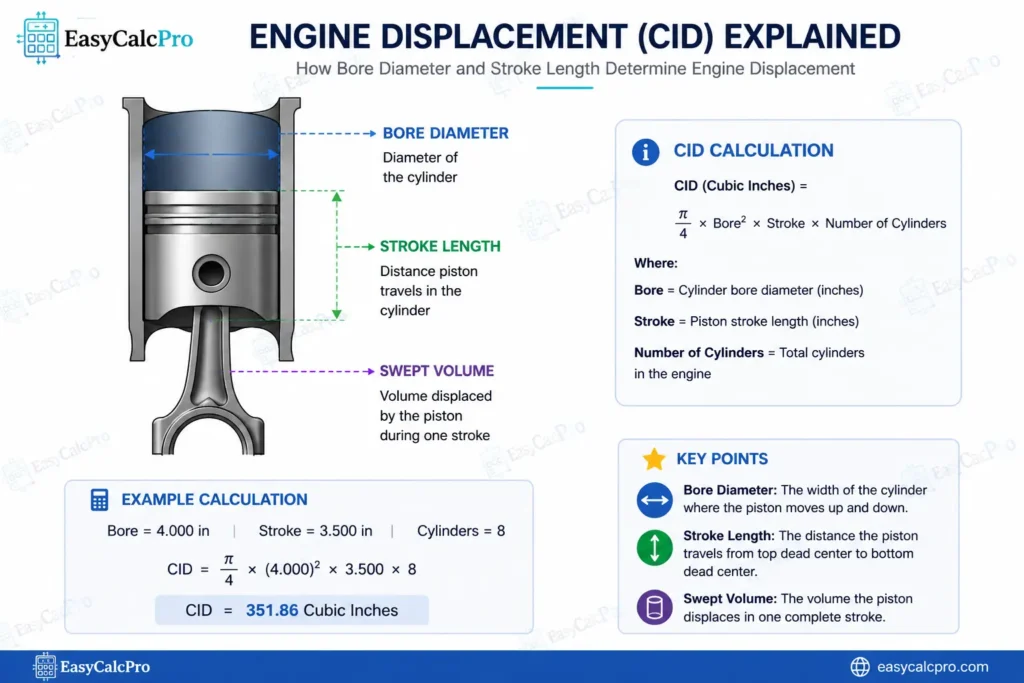
Engine Displacement Calculator: Complete Guide
Engine displacement is one of the most important specifications of any internal combustion engine. It represents the total volume swept by all pistons as they move from Top Dead Center (TDC) to Bottom Dead Center (BDC).
Manufacturers usually express displacement in:
- Cubic centimeters (cc)
- Liters (L)
- Cubic inches (CID or cu in)
A larger displacement generally means the engine can move more air and fuel during each cycle, although overall performance also depends on turbocharging, compression ratio, valve timing, fuel delivery, and engine efficiency.
Our Engine Displacement Calculator makes this calculation fast and accurate without requiring manual formulas.
What Is Engine Displacement?
Engine displacement is the combined volume of every cylinder inside an engine.
As each piston travels downward, it sweeps a certain amount of volume. When you add together the volume of all cylinders, you get the engine's total displacement.
For example:
- 998 cc motorcycle engine
- 2.0 L four-cylinder engine
- 5.7 L V8 engine
- 350 cubic inch V8
All of these values describe engine displacement.
How the Engine Displacement Calculator Works
The calculator requires only three measurements:
- Cylinder Bore
- Stroke Length
- Number of Cylinders
It then calculates:
- Single cylinder displacement
- Total engine displacement
- Cubic centimeters (cc)
- Liters
- Cubic inches (CID)
This eliminates manual calculations and reduces errors.
Engine Displacement Formula
The standard engine displacement formula is:
Displacement = π ÷ 4 × Bore² × Stroke × Number of Cylinders
Where:
- π = 3.14159
- Bore = cylinder diameter
- Stroke = piston travel distance
- Bore and stroke must use the same unit.
- Multiply by the number of cylinders.
This is the universal formula used by engine manufacturers and mechanics worldwide.
Formula for Piston Displacement
For a single cylinder:
Cylinder Volume = π ÷ 4 × Bore² × Stroke
The total engine displacement is simply:
Total Displacement = Cylinder Volume × Number of Cylinders
Volume Displacement Formula Engine
The engine's swept volume is calculated using the cylindrical volume equation.
Volume of Cylinder:
V = πr²h
Since the bore is the diameter:
r = Bore ÷ 2
Substituting gives:
V = π ÷ 4 × Bore² × Stroke
This is the same formula used in every engine displacement calculator.
Step-by-Step Calculation Example
Suppose an engine has:
- Bore = 86 mm
- Stroke = 86 mm
- Cylinders = 4
Step 1:
Square the bore.
86 × 86 = 7396
Step 2:
Multiply by stroke.
7396 × 86
Step 3:
Multiply by π ÷ 4.
Step 4:
Multiply by 4 cylinders.
Final displacement:
Approximately 1998 cc
or
2.0 liters
Engine Bore Calculator Explained
The engine bore is the inside diameter of each cylinder.
Increasing bore increases cylinder volume because the piston has a larger surface area.
Performance builders often increase bore when rebuilding an engine to gain additional displacement.
A bore calculator helps estimate new displacement after machining cylinders.
Measuring Engine Displacement
To calculate displacement accurately, you need correct measurements.
Measure Bore
Use:
- Vernier caliper
- Digital caliper
- Dial bore gauge
Measure the cylinder diameter.
Measure Stroke
Rotate the crankshaft while measuring piston travel.
Common tools include:
- Dial indicator
- Depth gauge
Count Cylinders
Multiply the single-cylinder displacement by the total number of cylinders.
Examples:
- Inline 4 = 4 cylinders
- V6 = 6 cylinders
- V8 = 8 cylinders
- Boxer 4 = 4 cylinders
Engine Displacement Units
Engine displacement can be expressed in several units.
Cubic Centimeters (cc)
Most motorcycles and small engines use cubic centimeters.
Examples:
- 125 cc
- 250 cc
- 650 cc
Liters (L)
Passenger vehicles typically use liters.
Examples:
- 1.5 L
- 2.0 L
- 3.5 L
Cubic Inches (CID)
Older American engines commonly use cubic inches.
Examples:
- 302 CID
- 350 CID
- 454 CID
Cubic Inches to Liters Conversion
Common conversions include:
| Cubic Inches | Liters |
|---|---|
| 302 | 4.95 L |
| 305 | 5.0 L |
| 327 | 5.36 L |
| 350 | 5.74 L |
| 383 | 6.28 L |
| 427 | 7.0 L |
| 454 | 7.44 L |
Liters to Cubic Inches
Approximate conversions:
| Liters | Cubic Inches |
|---|---|
| 1.0 L | 61 CID |
| 2.0 L | 122 CID |
| 3.0 L | 183 CID |
| 4.0 L | 244 CID |
| 5.0 L | 305 CID |
| 6.2 L | 378 CID |
Why Engine Displacement Matters
Engine displacement affects many aspects of vehicle performance.
Benefits include:
- Better towing capability
- Increased low-end torque
- Higher power potential
- Improved throttle response
- Better suitability for heavy vehicles
However, larger engines may also consume more fuel depending on engine design and driving conditions.
Common Uses of an Engine Displacement Calculator
People commonly use this calculator when:
- Building racing engines
- Swapping engines
- Reboring cylinders
- Installing stroker kits
- Comparing engines
- Restoring classic cars
- Designing custom engines
- Calculating motorcycle engine size
Common Mistakes to Avoid
To ensure accurate results:
- Use the same measurement unit for bore and stroke.
- Double-check cylinder count.
- Measure bore accurately after machining.
- Measure stroke from TDC to BDC.
- Convert units only after calculating if necessary.
- Round results only at the end.
Frequently Asked Questions
What is engine displacement?
Engine displacement is the total volume swept by all pistons inside an engine during one complete stroke.
How do I calculate engine displacement?
Multiply the volume of one cylinder by the total number of cylinders using the standard displacement formula.
Is engine displacement the same as engine size?
Yes. Terms such as engine size, engine capacity, and engine displacement generally refer to the same specification.
Does a larger displacement always mean more horsepower?
Not necessarily. Horsepower also depends on airflow, compression ratio, turbocharging, fuel delivery, engine tuning, and other design factors.
Can I calculate displacement using inches?
Yes. As long as bore and stroke use the same unit, the formula works for millimeters, centimeters, or inches.
Why do manufacturers use liters instead of cubic inches?
Most modern manufacturers use liters because it is the international standard, while many older American engines are identified by cubic inches.
Is engine bore more important than stroke?
Both are equally important. Bore affects cylinder diameter, while stroke determines piston travel. Together they determine total displacement.
Conclusion
An accurate engine displacement calculation helps mechanics, enthusiasts, engineers, and vehicle owners understand an engine's true capacity. Whether you're planning an engine rebuild, selecting performance components, comparing specifications, or verifying factory data, using an Engine Displacement Calculator provides fast and reliable results. By entering the correct bore, stroke, and cylinder count, you can instantly determine engine size in cubic centimeters, liters, or cubic inches and make better-informed decisions for maintenance, upgrades, or new engine builds.