
Tire Size Calculator: Calculate Tire Dimensions and Specs Instantly
A tire size calculator is the fastest way to determine your tire’s true dimensions before you buy. Whether you’re upgrading to larger tires, downsizing for winter, or simply checking for speedometer error, this free tire size calculator computes your tire height, section width, sidewall height, circumference, and revolutions per mile in seconds — using nothing more than the three numbers printed on your tire’s sidewall.
Tire Size Calculator: Calculate Tire Dimensions and Specs Instantly
A tire size calculator is the fastest way to determine your tire’s true dimensions before you buy. Whether you’re upgrading to larger tires, downsizing for winter, or simply checking for speedometer error, this free tire size calculator computes your tire height, section width, sidewall height, circumference, and revolutions per mile in seconds — using nothing more than the three numbers printed on your tire’s sidewall.
Below, you’ll learn exactly how to calculate tire size by hand, what every number in a tire code means, and how to use our tire size chart to compare popular metric sizes.
How to Use a Tire Size Calculator
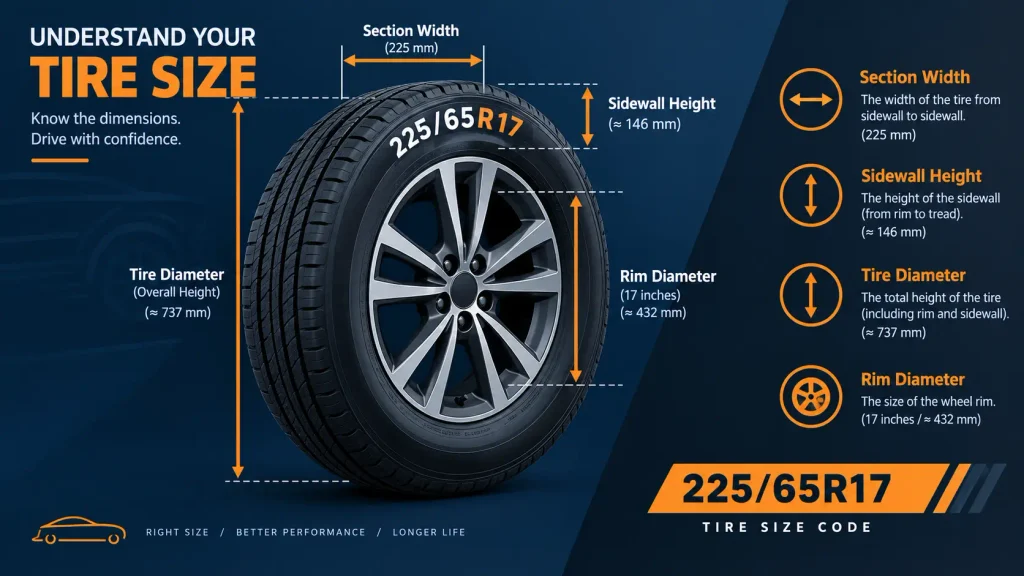
Every passenger tire carries a standardized code such as 225/65R17 or 245/40R18. A tire size calculator reads three values from that code:
- Section Width — the width of the tire in millimeters (the number before the slash)
- Aspect Ratio — the sidewall height as a percentage of the width (the number after the slash)
- Rim Diameter — the wheel size in inches (the number after the “R”)
Enter these into the calculator, and it instantly returns your tire height, circumference, sidewall measurement, and revolutions per mile.
How to Calculate Tire Size by Hand
Want to verify the numbers yourself? Here are the four simple formulas behind every tire size calculator.
How to Calculate Sidewall Height
The sidewall height is determined by the section width and the aspect ratio:
Sidewall = Section Width × (Aspect Ratio ÷ 100)
For a 245/40R18 tire: Sidewall = 245mm × 0.40 = 98mm
How to Calculate Tire Height (Diameter)
Diameter = (2 × Sidewall) + Rim Diameter
Converting 98mm to inches (3.86″): Diameter = (2 × 3.86″) + 18″ = 25.72″
How to Calculate Tire Circumference
Circumference = Diameter × π (3.14159)
Circumference = 25.72″ × 3.14159 = 80.8 inches
How to Calculate Revolutions Per Mile
Rev/Mile = 63,360 ÷ Circumference
Rev/Mile = 63,360 ÷ 80.8″ = 784.16 revolutions per mile
Note: Revolutions per mile will vary, usually by around 3%, when the tire is under the load of the vehicle.
How to Read Tire Size Numbers
Every letter and number in the code tells you something important:
- Vehicle Type Letter — P = Passenger, LT = Light Truck, ST = Special Trailer, T = Temporary spare
- Section Width — measured in millimeters, from inner sidewall to outer sidewall
- Aspect Ratio — a 65 aspect ratio means the tire’s height is 65% of its width
- Construction — R = radial ply (standard on modern cars), D = diagonal ply, B = bias-belted
- Rim Diameter — the wheel diameter in inches the tire fits
- Load Index — a 2- or 3-digit code (70–126) indicating maximum load per tire
- Speed Rating — the final letter, indicating the tire’s maximum sustained speed capability
Tire Size Chart: Common Metric Sizes
Use this quick reference alongside our tire size calculator to compare popular sizes:
| Tire Size | Section Width | Tire Height |
|---|---|---|
| 235/75R15 | 9.25″ | 28.9″ |
| 265/75R16 | 10.4″ | 31.6″ |
| 245/70R17 | 9.6″ | 30.5″ |
| 285/70R17 | 11.2″ | 32.7″ |
| 275/65R18 | 10.8″ | 32.1″ |
| 275/65R20 | 10.8″ | 34″ |
What About Flotation Tires?
Light truck and off-road tires often use flotation sizing, such as 28.5x9R17LT. Unlike metric sizes, these are measured in inches:
- 28.5 = tire height/diameter in inches
- 9 = section width in inches
- R17 = radial construction, 17-inch rim
- LT = light truck vehicle type
You can convert between flotation and metric sizes using a tire size conversion calculator.
Why Accurate Tire Size Matters
Changing tire sizes affects more than looks. An incorrect size can cause:
- Speedometer error — larger tires make your speedo read slower than your actual speed
- Fender or suspension clearance issues — always check inner and outer clearance when upsizing
- Incorrect gearing — significantly taller tires reduce acceleration and increase strain on drivetrain components
That’s why running the numbers through a tire size calculator before purchasing is essential.
Frequently Asked Questions
Where do I find my tire size?
Check the sidewall of your current tire, or the yellow/white “Tire and Loading Information” sticker inside the driver’s door jamb. Note that the installed tires may differ from the manufacturer’s recommended size.
How much does rev/mile vary in real driving?
Under vehicle load, revolutions per mile typically vary by about 3% compared to the calculated value.
Can I use a tire size calculator for metric and flotation tires?
Yes. Enter metric sizes (e.g., 225/65R17) or flotation sizes (e.g., 28.5x9R17) — both formats work.